

Gymnastics is a sport that combines strength, flexibility, balance, and precision, making it both challenging and rewarding. Whether you’re a beginner or an experienced gymnast, mastering fundamental gymnastics moves is essential for progressing to more advanced skills and routines. In this comprehensive guide, we’ll explore essential gymnastics moves, tips for perfecting them, and how they contribute to a well-rounded gymnastics practice.
Table of Contents
Gymnastics Moves on Floor
Gymnastics Moves on Beam
Gymnastics Moves on Bars
Gymnastics Moves on Vault
Tips for Mastering Gymnastics Moves
Common Mistakes and How to Avoid Them
Safety Tips for Practicing Gymnastics
Introduction to Gymnastics Moves
Gymnastics moves range from simple to complex, each requiring a unique blend of strength, coordination, and practice. Understanding the different categories of gymnastics moves helps gymnasts at all stages of their training to progress safely and effectively.

Gymnastics Moves on Floor
Gymnastics skills, or moves, on floor fall into one of the categories we have outlined below. We also have a list of gymnastics skills, that includes a free printable checklist.
Leaps
A split leap is usually part of the dance in both your floor and beam routines. A switch leap is an advanced leap that can help you earn difficulty in your gymnastics routines.
- Why it’s important: Leaps showcase a gymnast’s strength and flexibility. They are also key components of routines that contribute to the artistry score.
- How to improve: Focus on leg strength, flexibility (especially in the legs and hip flexors), and core stability to improve height and form.
Here are some resources to check out for leaps:
- A Split Leap Workout You Can Do at Home
- 5 Drills to Improve Your Split Leap
- 3 Things You Can Do to Your Leaps Right Now to Improve Your Score
Jumps/Hops
Gymnastics jumps and hops are utilized in every level of gymnastics in floor and beam routines. They showcase a gymnast’s flexibility and grace.
- Why it’s important: Jumps highlight a gymnast’s power, control, and flexibility. They are also key components of routines that contribute to the artistry score.
- How to improve: Focus on leg strength, flexibility (especially in the legs and hip flexors), and core stability to improve height and form.
Here are some resources to check out for jumps:
Turns
Turns are also used in every level in gymnastics; they are part of the dance element in floor and beam routines.
- Why it’s important: Turns highlight a gymnast’s artistry, control and balance. They are also key components of routines that contribute to the artistry score.
- How to improve: You can improve your turns by practicing spotting, strengthening your core and legs and practicing balance.
Here are some resources to check out for turns:
- How to Do a Gymnastics Full Turn
- Deductions in a Full Turn
- How to Do a Squat Turn
- 3 Drills to Improve Your Gymnastics Turns
- 3 Alternatives to Doing a Pivot Turn
- The Wolf Turn in Gymnastics- Tutorial, Drills, Skill Values and more!
Handstands
The handstand, in our opinion, is the #1 gymnastics skill to master because it is utilized in all 4 events in gymnastics.
The handstand is one of the most foundational gymnastics moves that appears in almost every discipline, from floor routines to the balance beam and even on the uneven bars. Perfecting a handstand is key to progressing in gymnastics, as it builds core strength, balance, and control.
- Why it’s important: Many advanced moves, such as cartwheels, back handsprings, and giants on bars, are based on the handstand position.
- How to improve: Work on core stability, arm strength, and alignment. Practice holding a handstand against a wall before progressing to freestanding.
Here are some resources to check out for handstands:
- How to Do a Handstand for Beginners
- 5 Handstand Drills for Beginners
- #1 Way to Improve your Handstand
- 4 Tips to Hold Your Handstand Longer
- 5 Minute Handstand Workout
- 3 Advanced Handstand Drills
- 5 Handstand Upgrades you Should Practice Now
- How to Do a Press Handstand
- Press Handstand Workout You Can Do at Home
- How to do a Handstand Pirouette
Cartwheels/Round-Offs
A cartwheel is a beginner gymnastics skill that is performed on both floor and beam.
- Why it’s important: Cartwheels teach body awareness and movement coordination. They are essential for floor exercises and are also a building block for skills like round-offs and aerials.
- How to improve: Practice on a soft surface or with a line on the ground to maintain straight body alignment.
Rolls
Forward rolls and backward rolls are both skills that can be performed on floor or beam. They are elementary skills and are the foundation for more advanced skills like a back extension roll for Level 4.
- Why it’s important: Rolls are beginner gymnastics skills to get gymnast’s comfortable using their body.
- How to improve: Practice on a soft surface or with a line on the ground to maintain straight body alignment.
Walkovers
There are two main types of walkovers in gymnastics: a back walkover and a front walkover. It’s commonly used in floor routines and on balance beam.
- Why it’s important: Back walkovers are important for transitioning between skills and help build confidence in backward movement, before you move on to back handsprings.
- How to improve: Work on back flexibility and strength in your arms and legs. Start with bridge drills to develop the necessary backbend flexibility.
Here are some resources on walkovers and progressions:
- How to Do a Bridge in Gymnastics
- How to Do a Bridge Kickover
- How to Do a Back Limber in Gymnastics: A Step-by-Step Guide with Drills
- How to Do a Back Handspring: The Best Drills and Exercises to Help You Learn
- How to Do a Front Handspring
Saltos
There are two main types of saltos in gymnastics: a front salto and a back salto. Saltos can be performed in the tuck, pick or layout positions. Front and back tucks are essential flips in gymnastics. The back tuck, where you jump and flip backward, and the front tuck, where you flip forward, are common in both floor and vault routines.
- Why it’s important: Saltos build air awareness and are often linked with more advanced skills like twists and layouts.
- How to improve: Work on jump height, core strength, and proper timing for pulling your knees in tightly to rotate faster.
Here is a resource for saltos:

Gymnastics Moves on Beam
Gymnastics skills, or moves, on beam fall into one of the categories we have outlined below. We also have a list of gymnastics skills on beam, that includes a free printable checklist.
Mounts
A beam mount is a move that gymnasts use to get onto the balance beam at the beginning of their routine. Most gymnasts mount the beam from one end, but some mount from the side. Mounts vary in difficulty.
- Why it’s important: A mount is a crucial component because it sets the tone for the entire routine. The mount is often the first element judges and spectators see, so it’s crucial for making a strong first impression.
- How to improve: Work on mastering the specific technique and build strength in the key muscle groups involved in your mount – core strength, leg power, and upper body strength are critical for most mounts.
Leaps
A split leap is usually part of the dance in both your floor and beam routines. A switch leap is an advanced leap that can help you earn difficulty in your gymnastics routines.
- Why it’s important: Leaps showcase a gymnast’s strength and flexibility. They are also key components of routines that contribute to the artistry score.
- How to improve: Focus on leg strength, flexibility (especially in the legs and hip flexors), and core stability to improve height and form.
Here are some resources to check out for leaps:
- A Split Leap Workout You Can Do at Home
- 5 Drills to Improve Your Split Leap
- 3 Things You Can Do to Your Leaps Right Now to Improve Your Score
Jumps/Hops
Gymnastics jumps and hops are utilized in every level of gymnastics in floor and beam routines. These can be done facing the end of the beam (cross) or side position.
- Why it’s important: Jumps highlight a gymnast’s power, control, and flexibility. They are also key components of routines that contribute to the artistry score.
- How to improve: Focus on leg strength, flexibility (especially in the legs and hip flexors), and core stability to improve height and form.
Here are some resources to check out for jumps:
Turns
Turns are also used in every level in gymnastics; they are part of the dance element in floor and beam routines.
- Why it’s important: Turns highlight a gymnast’s artistry, control and balance. They are also key components of routines that contribute to the artistry score.
- How to improve: You can improve your turns by practicing spotting, strengthening your core and legs and practicing balance.
Here are some resources to check out for turns:
- How to Do a Gymnastics Full Turn
- Deductions in a Full Turn
- How to Do a Squat Turn
- 3 Drills to Improve Your Gymnastics Turns
- 3 Alternatives to Doing a Pivot Turn
- The Wolf Turn in Gymnastics- Tutorial, Drills, Skill Values and more!
Waves or Holds
A wave in gymnastics is similar to the motion of a crowd “wave”. It is a fluid contraction of the body that moves through the hips, shoulders, arms and head of the gymnast.
A hold is simply what it sounds like – it’s a static (holding) position of a skill or movement in gymnastics.
- Why it’s important: Waves and holds are crucial elements that contribute to a gymnast’s performance, particularly in terms of fluidity, control, and expression.
- How to improve: Focusing on technique, strength, flexibility, and body awareness, you can improve your ability to perform waves and holds with greater control, precision, and artistic flair, ultimately elevating your gymnastics performance.
Here is a resource to check out for holds:
Handstands
The handstand, in our opinion, is the #1 gymnastics skill to master because it is utilized in all 4 events in gymnastics.
- Why it’s important: Many advanced moves, such as cartwheels, back handsprings, and giants on bars, are based on the handstand position.
- How to improve: Work on core stability, arm strength, and alignment. Practice holding a handstand against a wall before progressing to freestanding.
Here are some resources to check out for handstands:
- How to Do a Handstand for Beginners
- 5 Handstand Drills for Beginners
- #1 Way to Improve your Handstand
- 4 Tips to Hold Your Handstand Longer
- 5 Minute Handstand Workout
- 3 Advanced Handstand Drills
- 5 Handstand Upgrades you Should Practice Now
- How to Do a Press Handstand
- Press Handstand Workout You Can Do at Home
- How to do a Handstand Pirouette
- How to do a Handstand on Beam
Cartwheels/Round-Offs
A cartwheel is a beginner gymnastics skill that is performed on both floor and beam. A roundoff is similar to a cartwheel, but you land with both feet together instead of separately. Another form of a cartwheel is an aerial cartwheel which is a more advanced skill.
- Why it’s important: Cartwheels teach body awareness and movement coordination. They are essential for floor exercises and are also a building block for skills like round-offs and aerials.
- How to improve: Practice on a soft surface or with a line on the ground to maintain straight body alignment.
Rolls
Forward rolls and backward rolls are both skills that can be performed on floor or beam. They are elementary skills and are the foundation for more advanced skills like a back extension roll for Level 4.
- Why it’s important: Rolls are beginner gymnastics skills to get gymnast’s comfortable using their body.
- How to improve: Practice on a soft surface or with a line on the ground to maintain straight body alignment.
Walkovers
There are two main types of walkovers in gymnastics: a back walkover and a front walkover. A walkover can also be performed from a bridge starting position.
- Why it’s important: Back walkovers are important for transitioning between skills and help build confidence in backward movement, before you move on to back handsprings.
- How to improve: Work on back flexibility and strength in your arms and legs. Start with bridge drills to develop the necessary backbend flexibility.
Here are some resources on walkovers and progressions:
- How to Do a Bridge in Gymnastics
- How to Do a Bridge Kickover
- How to Do a Back Limber in Gymnastics: A Step-by-Step Guide with Drills
- How to Do a Back Handspring: The Best Drills and Exercises to Help You Learn
- How to Do a Front Handspring
Dismounts
A dismount in gymnastics is the way the gymnast leaves the beam. Dismounts also vary in difficulty. Common dismounts are a side handstand or salto.
- Why it’s important: Dismounts are your last impression on the judge so it’s important to leave a good one, by doing a clean, confident dismount. If you don’t stick your dismount, judges will deduct from your execution.
- How to improve: Practice your dismount and do applicable drills.

Gymnastics Moves on Bars
Gymnastics skills, or moves, on floor fall into one of the categories we have outlined below. We also have a list of gymnastics skills on bars, that includes a free printable checklist.
Mounts
A bar mount is a move that gymnasts use to get onto the uneven bars at the beginning of their routine. Mounts vary in difficulty.
- Why it’s important: The way a gymnast mounts the bar sets the tone for the routine, but can also add difficulty.
- How to improve: Most mounts require strong arm and core strength. You will also need to practice the timing.
Here are some resources to check out for bar mounts:
Casts
Beginner gymnasts start with a basic cast, where your hips and belly must get off the bar. As gymnasts get more advanced and compete at higher levels, they are required to do higher casts (you can find what angle here), all the way to a cast handstand.
- Why it’s important: Casts on bars are foundational movements that transition gymnasts from a support position to a handstand or prepare them for more advanced skills like release moves, dismounts, or combinations. They are the main building block skill for other gymnastics moves on bars, and judges will take deductions each time they are not done with proper form and to the right angle.
- How to improve: Improve your casts by developing more upper body strenght and working on your nice tight hollow body position.
Here are some resources to check out for casts:
Swings
A swing in gymnastics is simply moving the body backwards and forwards. There are a variety of different swings in gymnastics, ranging from basic tap swings, giants, etc.
- Why it’s important: Basic swings like tap swings, as well as more advanced swings like giants, are crucial for building momentum and rhythm on bars. They help gymnasts transition between skills on bars.
- How to improve: You can improve your swinging skills on bars by mastering your hollow and arch positions. Timing is crucial for generating momentum during swings. Focus on the tap technique—kicking your feet slightly forward and pushing with your shoulders at the bottom of the swing to switch between the arch and hollow position is what helps you swing higher and faster.
Here is a resource to check out for swings:
Hip Circles
A hip circle is a gymnastics move where the gymnast swings around the bar from their hips. The most common are the back hip circle, front hip circle, clear hip.
- Why it’s important: Hip circles, such as front hip circles and back hip circles, are foundational moves on the uneven bars and high bar. They help gymnasts learn how to maintain body control while rotating around the bar, which is essential for more advanced skills like giants and dismounts.
- How to improve: You can improve your hip circles by strengthening your core and arm muscles and working on your arch and hollow body positions.
Here is a resource to check out for hip circles:
Giants
Giants are full 360-degree swings around the high bar or uneven bars, where the gymnast rotates completely around the bar while maintaining a handstand position at the peak of the swing.
- Why it’s important: Giants are necessary for executing release moves, dismounts, and combinations on bars. They are a key element in high-level bar routines.
- How to improve: Perfect your handstand technique and develop strong grip and shoulder flexibility. Start with smaller swings and gradually increase the size of the rotation.

Stalder Circles
A stalder circle is a gymnastics move where the gymnast moves around the bar in a straddled position, while maintaining body tension.
- Why it’s important: Mastering the Stalder circle is key for performing more complex combinations and transitions.
- How to improve: You can improve your stalder circle by improving your straddle and shoulder flexibility. You also will need strong core muscles to be able to hold your body in the right position.
Release Moves
A release move in gymnastics is a move where the gymnast releases from the bar, performs another move and then re-grasps the bar. These can be done on the low bar, high bar, or transitioning between the two bars. Examples are a Gienger, Jaeger, Tkatchev, Toe Hecht & Liukin.
- Why it’s important: Release moves add a lot of difficulty value to elite gymnasts’ bar routines. They also help a gymnast move between the upper and lower bar in her routine.
- How to improve: Improve your upper body and core strength, along with your swinging skills to improve your entry into a release move. Then work on the timing.
Dismounts
A gymnastics dismount is the gymnasts final move on bars to complete the routine.
- Why it’s important: Bar dismounts are important because they add difficulty to a routine and showcase a gymnast’s ability to stick the landing.
- How to improve: You can improve your dismounts by working on your upper body and core strength as well as practicing the timing of a dismount.
Gymnastics Moves on Vault
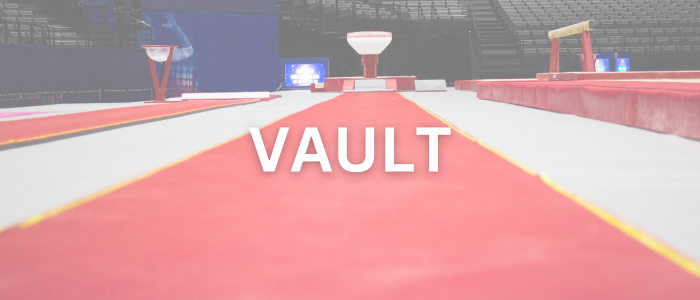
Gymnastics skills, or moves, on vault fall into one of the categories we have outlined below.
Handsprings
The gymnastics move of a handspring on vault is performed when a gymnast hurdles off of the springboard on her feet and completes a handspring off of the vault table facing forward.
- Why it’s important: A front handspring is one of the most fundamental, basic vaults and it really lays the foundation for more advanced vaults. It helps gymnasts learn about timing, body position and blocking.
- How to improve: Work on your run and entry onto the spring board, getting power off the board and then blocking off the table.
Here is a resource to check out for handsprings on vault:
Tsukhara Entry (or Tsuk for short) Vaults
The Tsuk gymnastics move is where the gymnast hurdles onto the springboard, does a half turn onto the vaulting table, and then flips backward.
- Why it’s important: Tsuk vaults are higher valued vaults that gymanst’s perform at upper levels. They can be made more difficult by adding extra flips or twists.
- How to improve: Your entry and body position are super important in a tsuk vault so that you can generate the power you need for the rest of the vault.
Yurchenko Entry Vaults
The Yurchenko is an advanced vault move that involves a round-off onto the springboard, a back handspring onto the vaulting table, and then a flip or twist off the vault.
- Why it’s important: This vault is performed by elite gymnasts and can be adapted into more difficult vaults by adding twists or extra flips.
- How to improve: Practice the components of the Yurchenko separately, including the round-off, back handspring, and tuck. Focus on explosiveness and timing.
Front Handspring Entry Vaults
Front Handspring entry vaults are gymnastics moves where the gymnast does a front handspring by putting her hands on the runway and then landing with her feet on the board. Then she performs a front handspring onto the vault table by repulsing off the board and putting her hands on the vault table, before landing on the ground.
- Why it’s important: This vault is performed by high level gymnasts, and can be increased in value by adding twists to the handspring off the vault table.
- How to improve: Practice your front handspring entry onto the spring board, so that you can get a fast repulsion off the springboard which will power your vault.
Tips for Mastering Gymnastics Moves
Strength Training: Building strength, particularly in the core, shoulders, and legs, is essential for executing gymnastics moves with precision and control.
Flexibility Exercises: Incorporate stretching and flexibility exercises into your routine to improve your range of motion and reduce the risk of injury.
Technique Refinement: Focus on proper technique and form. Work with a coach or use video analysis to identify and correct any technical flaws.
Common Mistakes and How to Avoid Them
Not being strong enough or flexible enough before trying to learn skills – we have the perfect solution to this – join our SkillTrakker program where we focus on building strength, flexibility, as well as focusing on improving basic skills, mindset, and more!
Incorrect Technique – again, SkillTrakker is perfect for working on proper form and technique that sometimes gets overlooked in practice.
Safety Tips for Practicing Gymnastics
Use Proper Equipment: Practice on appropriate mats and under the supervision of a coach.
Listen to Your Body: Avoid pushing through pain and rest when needed.
Gradual Progression: Build up to more complex moves slowly and safely.
Mastering gymnastics moves requires dedication, practice, and a commitment to safety. By focusing on fundamental skills, progressively tackling more advanced techniques, and following best practices, gymnasts can achieve remarkable progress. Whether you’re just starting out or looking to perfect your routine, this guide provides the essential knowledge needed to excel in the sport of gymnastics.
Feel free to refer back to this guide as you continue your gymnastics journey, and always strive for improvement with a focus on technique and safety. Happy training!


3 Comments