
Figuring out what the skill values are for skills in your routines can be complicated. We know that some coaches leave the choreography and skills up to the gymnast and that can be a little overwhelming. We’ve decided to break down some common jump skill values for you here for both floor and beam (all of these values are for the Developmental Program unless otherwise noted)!

Straight Jump
The straight jump is a common jump you’ll see from the very earliest routines to the more complex routines. On both floor and beam, the values range from A to D.
Floor:
- Straight Jump – A
- Straight Jump with 1/2 turn – A
- Straight Jump with 1 1/2 turn – B
- Straight Jump with 2/1 turn – C
- Straight Jump with 2 1/2 turn – C
- Straight Jump with 3/1 turn – D
Beam – performed in either side (sideways on the beam) or cross (facing the end of the beam) position:
- Straight Jump – A
- Straight Jump with 3/4 turn – B
- Straight Jump with 1/1 turn – C
- Straight Jump with 1 1/4 turn – C
- Straight Jump with 1 1/2 turn – D

Tuck Jump
In the Xcel levels, both legs have to be together with knees at horizontal or above with 90º at hips and knees to earn the value point for a tuck jump. Tuck jumps with > 135º hip angle and >90º knees will earn the value point performed. The tuck jump in Xcel can receive deductions for not achieving sufficient hip and knee height (insufficient exactness of the tuck position), leg or knee separations, insufficient height on the jump.
In the Developmental program, if the gymnast performs an additional 1/4 turn in the jump, they will be awarded the same value part as the root jump unless it’s specifically listed under a different number. For example, a tuck jump 1 1/4 would be an A value on floor, however a tuck jump 1 1/2 is also an A value on floor. A tuck jump 1/1 turn is a B value on floor as well as a tuck jump 1 1/4 turn, but a tuck jump 1 1/2 is defined as a C value.
Floor:
- Tuck Jump – A
- Tuck Jump 1 1/2 – A
- Tuck Jump 1/1 – B
- Tuck Jump 1 1/2 – C
- Tuck Jump 2/1 – D
Beam:
- Tuck Jump – A
- Tuck Jump 1/2 – B
- Tuck Jump 3/4 – C
- Tuck Jump 1/1 – D
- Tuck Jump 1 1/4 – D
- Tuck Jump 1 1/2 – E
Pike Jump
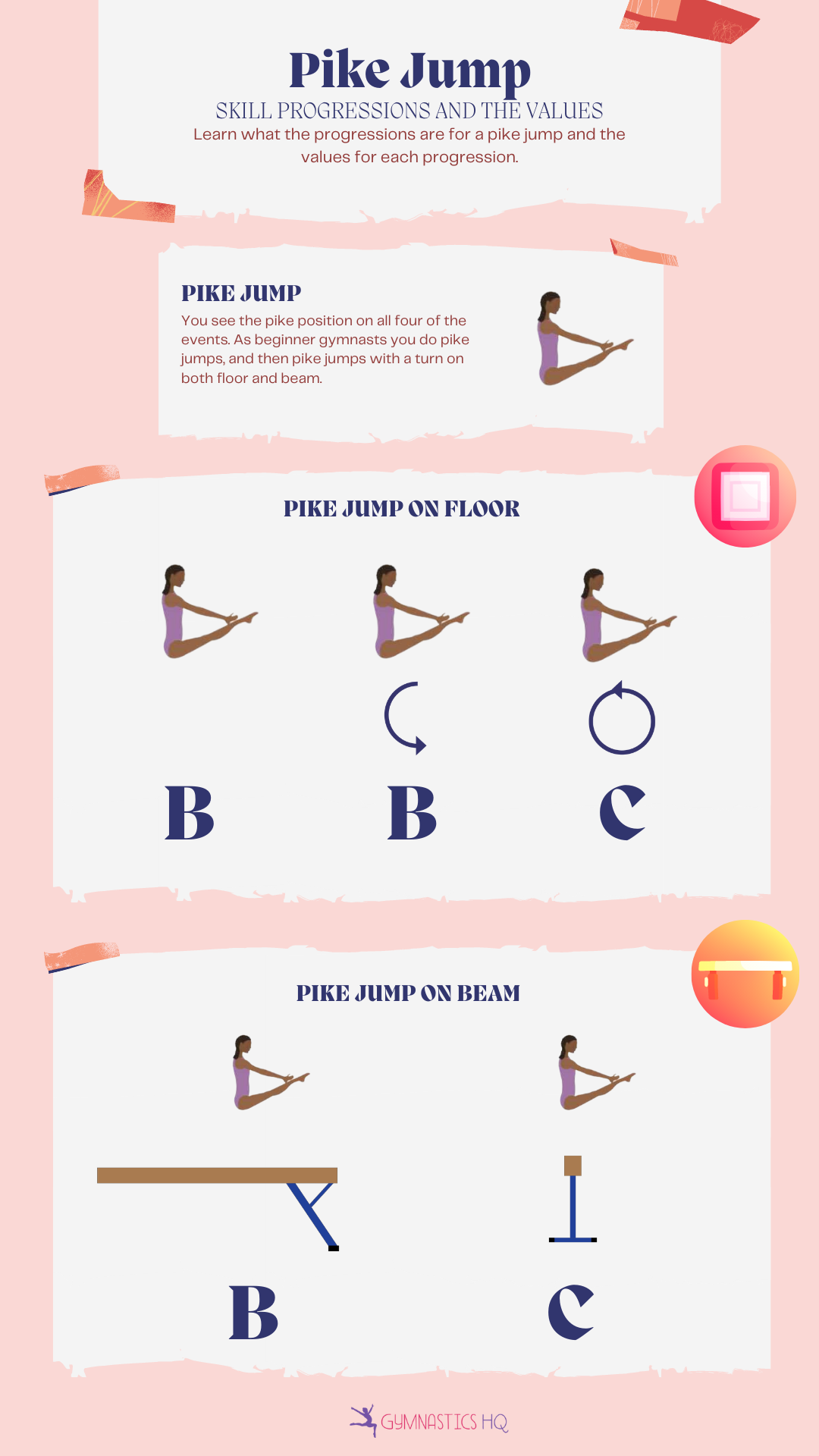
The pike jump has only 3 options on floor, but it has 6 different options on beam since the difficulty changes based on which way the gymnast is facing. Judges are looking for a minimum of 90º hip angle in the pike jump.
Floor:
- Pike Jump – B
- Pike Jump 1/2 – B
- Pike Jump 1/1 – C
Beam:
- Pike Jump Cross Position – B
- Pike Jump Side Position – C
- Cross Pike Jump 1/2 – C
- Side Pike Jump 1/2 or 3/4 – D
- Cross Pike Jump 3/4 – D
- Cross or Side Pike Jump 1/1 – E
Straddle Jump
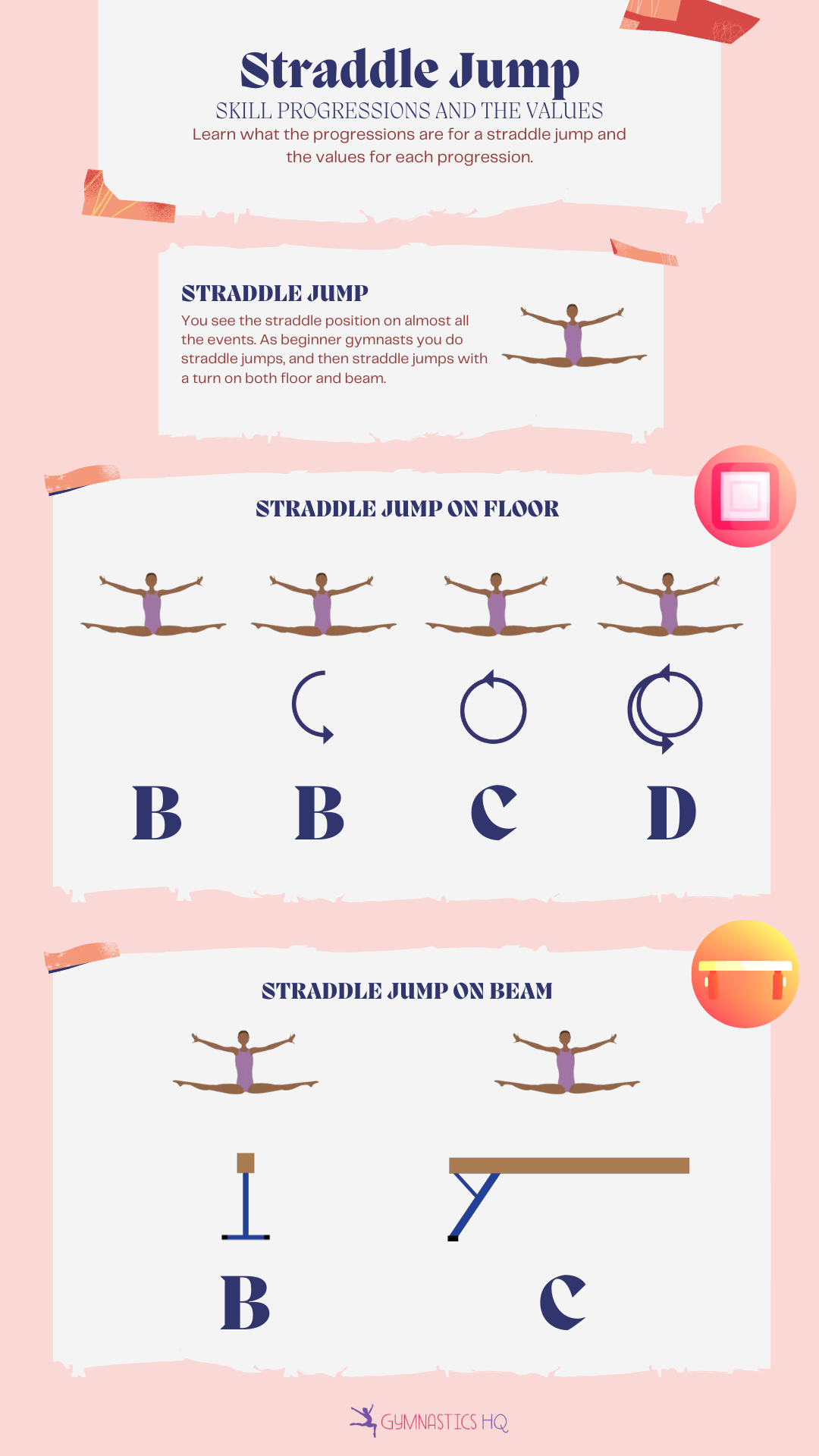
It isn’t very popular to do a straddle jump on beam, but it can be a good option in Xcel where you can do a smaller jump to get credit. Changing positioning from cross to side with the straddle jump can change the skill from a B to a C skill.
In Xcel, there are different angle requirements: Bronze has a minimum 60-180º or greater, Silver has a minimum of 90º angle, Gold has a minimum of 120º angle, Platinum and Diamond both have a minimum of 150º angle. In Xcel Bronze, any split angle is an A skill. Straddle Cross Jumps and Straddle Cross/Side Jumps with 1/4 turns are B and C skills depending on the direction of the jump.
Floor:
- Straddle Jump – B
- Straddle Jump 1/2 – B
- Straddle Jump 1/1 – C
- Straddle Jump 1 1/2 – D
Beam – 180º minimum angle requirement:
- Side or Cross Straddle Jump – B
- Side Straddle Jump 1/4 – B
- Cross Straddle Jump 1/4 – C
- Side or Cross Straddle Jump 1/2 or 3/4 – D
- Side or Cross Straddle Jump 1/1 – E

Wolf Jump
Doing wolf jumps is less popular now than it has been in the past, but some gymnasts definitely still do them. Here are the values for a wolf jump.
Floor:
- Wolf Jump – A
- Wolf Jump 1/2 – B
- Wolf Jump 1/1 – C
- Wolf Jump 1 1/2 – D
Beam (in either side or cross position):
- Wolf Jump – A
- Wolf Jump 1/2 – B
- Wolf Jump 3/4 – C
- Wolf Jump 1/1 D
We hope you’ve found these information helpful and easy to understand! Feel free to save the images for reference!

14 Comments
Thank you so much for these jump values! They often are tricky to remember. I’m putting together a routine for the competition season which starts in 5 months. Looking forward to adding new jumps and series into my routines! Thank you, Jessica!
Of course! Awesome!
Wow this a great work and an awesome help !
You are super ! Thx
No problem!
Gracias
The stretch jump on floor has no value in the Xcel or Dev program. It cannot be used to fulfill the required number of skills in any Level/Division . See floor exercise elements p. 9 box #1.112 in the current Xcel Code of Points.
So I see tuck one and a half on floor is an A and a C which one is it ? Am I missing it
I think its a typo… It meant to say 1/2
I couldn’t believe my eyes when I saw a full wolf jump is a C!!! And I’m only a level 3 gymnast
Thank you for the guidance!
Thanks for breaking this down—it really helps simplify things for gymnasts and coaches alike! I’ve actually seen a few gymnasts use CapCut to film and edit their routines, adding slow-mo effects and text overlays to analyze skill values visually.