
The straight jump might seem like a simple element in gymnastics, but executing it with perfect form can make a huge difference in your overall floor routine. A well-performed straight jump showcases excellent technique, control, and artistry, helping gymnasts develop the foundation for more advanced skills. Whether you’re a beginner gymnast or a seasoned athlete looking to fine-tune your jumps, this guide will provide key tips and exercises to help you master the straight jump.
If you are looking to improve your jumps overall, check out our article on how to improve your jumps in gymnastics.
What Is a Straight Jump?
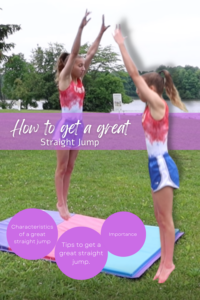
A straight jump is a basic jump in gymnastics where the gymnast lifts off the floor, keeping the body fully extended, with legs together, toes pointed, and arms typically reaching above the head. While in the air, the body should form a straight line from fingers to toes, with minimal bending at the hips or knees. The goal is to show clean lines, height, and control both in the air and upon landing.
Characteristics of a Great Straight Jump
Keeping a tight, straight body position is important in a great straight jump. You want to make sure that your body is tight and straight, from the tips of your fingers all of the way down to your pointed feet. This means your body alignment is completely vertical, your bottom is squeezed, your arms are tight by your ears, your arms and legs are straight with your chin off of your chest. We practice this position in our relevé hold drill at 2:42, and by stretching tall.
Getting high off of the ground means that the height of your straight jump is good. There are plyometric drills that can help with this aspect of getting a great straight jump like squat jumps (1:41) and straight body punches (35 secs). The goal of the straight body punches is to complete the jumps without bending your knees, but still trying to get as high as you can while maintaining your tight body positioning.
Standing tight in your landing without bobbling so that you’re basically sticking your landing. You can practice this by doing all of the drills listed above, as well as practicing your straight jumps, and making sure that you stick your landing each time! You can also do this off of higher surfaces.
Common Mistakes to Avoid when Doing a Straight Jump in Gymnastics
- Bending at the Hips or Knees
- A straight jump should be exactly that—straight. Avoid bending at the waist, hips, or knees while in the air.
- Uncontrolled Arms
- Flailing arms can throw off your balance and make the jump look messy. Make sure your arms stay in line with your ears throughout the jump.
- Weak Takeoff
- A common mistake is not pushing off the floor powerfully enough. Make sure to fully extend through your feet and ankles to get maximum height.
- Hard Landings
- A loud, uncontrolled landing takes away from the smoothness of your jump. Practice landing softly by absorbing the impact with bent knees and keeping your body aligned.
Importance of a Great Straight Jump
Straight jumps, as we discussed earlier, are a pretty important basic skill. The straight jump can be a part of a lot of different jump combinations that can be in your beam or floor routines.
They’re a great plyometric drill for tumbling skills and hitting the board for several vaults.
We hope you’ve learned something from this post! As always, if you’re looking to improve your gymnastics skills in less than 15 minutes a day at home, we’d love for you to join our SkillTrakker community of gymnasts who are working towards this everyday!


7 Comments
Thanks
You’re welcome!
Thanks for the reminders! I am not a beginner but I am going through all your posts to help me get better. 🙂