
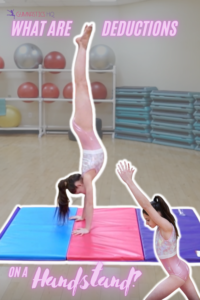
If you’ve been following us for awhile, you know by now that we feel the very most important skill, in gymnastics, is the handstand. There are a number of reasons for this, the biggest being that it is used in all four events.
As in our post about deductions in a turn, the same rules apply – each different gymnastics program has its own set of rules and the deductions can vary slightly between the Xcel, Compulsory, the Developmental Program, or any other gymnastics program. Let’s check out what the main areas that judges are looking at with the handstand, regardless of what program you’re in.

Flexed/Sickled Feet
How many times has your coach said to you, “point your feet!”? We know EVERYONE has heard that a time or two! Gymnasts can receive .05 point deduction for EACH time their feet are flexed in their handstand. Judges want to see your feet pointed throughout your handstand in each phase – from the time your foot leaves the floor until it touches back down, they are looking for nice, tight, pointed feet. Watch this video from 1:12-1:32 for a drill to help with your pointed toes.

Insufficient Exactness of Stretched Position
In this area, judges will take deductions up to .2 for not having a tight, straight body position. They are looking for vertical 180º positioning while the gymnast pushes through her shoulders. A good tip is to “grow tall” pulling towards the ceiling. One of our favorite drills that can help work on the positioning is the spiderman handstand which you can see in this video from 4:41-5:29 and the t-shirt shaping drill from 1:32-2:27 in the same video is also a drill that can help work on better positioning in your handstand.

Bent Arms in Support Position or Bent Legs
This is a big area where gymnasts can get some serious deductions with handstands. A gymnast can receive up to .3 for bent arms in support position and up to .3 for bent legs in their handstand depending on which program you are in. The larger the bend in your arms or legs, the greater the deduction is. Keep in mind, a gymnast can receive the deduction for both arms and legs. Our handstand workout video has some great drills to help improve your handstand.

Leg or Knee Separation
Gymnasts can receive up to a .2 deduction in their handstand in their knees or legs are separated in their handstand. It’s important to keep a nice, tight body position while squeezing your thighs, legs and feet together. The last drill in this video can help work on keeping your legs, knees and feet in a tight position to work on not separating them in your handstand.
Make sure to check out our videos on advanced handstand drills and tips to hold your handstand longer too!

5 Comments
Judges also look first for Attain VERTICAL/ or required degree to vertical with legs closing together, if required.. Hold in vertical, close of legs or performance with legs/ hips in optional pose, with shoulders to hips in vertical position……
♀️ ✋ ❗️ I can not hold my handstand for the amount of time I want to and these drills are helpful bye don’t fully demonstrate what to do is there any more drills for advanced
Hi – yes, we have several other posts with YouTube videos for handstand drills and tips to hold your handstand longer! Here are a few:
https://gymnasticshq.com/4-tips-to-hold-your-handstand-longer/
https://gymnasticshq.com/5-minute-handstand-workout/
https://gymnasticshq.com/3-advanced-handstand-drills/
Hope these help!
I thought this article thingy helped me found out different ways I could get a deduction.
With a Time Duration Calculator, evaluating elapsed time feels logical and precise.