
Are you interested in learning how to do a cartwheel?
But you aren’t sure where to start?

How to Do a Cartwheel (Beginner Guide + Video & Drills)
Start With A Baby Cartwheel
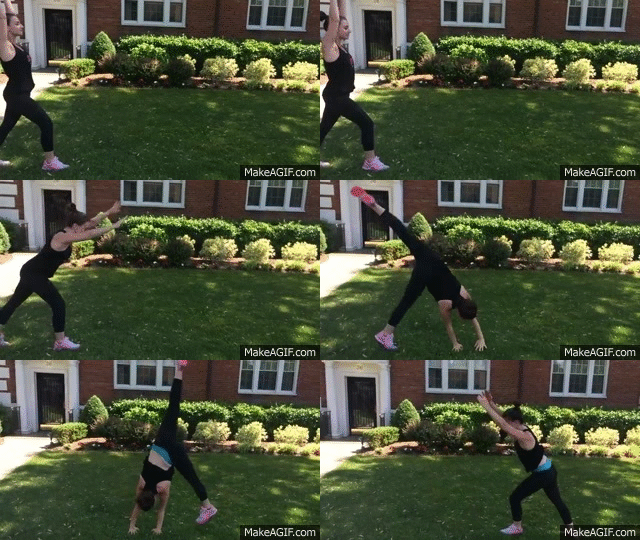
You can learn how to do a cartwheel in one day, but you will first need to start with a baby basic cartwheel and then work on perfecting it. In the cartwheel below the gymnast kicks around the side and does a baby cartwheel. Whereas, in the cartwheel above she correctly kicks vertically over her head. As you practice you will get better and better, and be able to do a correct cartwheel.

One of the keys to learning a perfect cartwheel is practice. In our article on the power of repetition, we share a personal example about learning how to do a cartwheel. In order to learn the same way as in our story, complete this 1,000 cartwheel challenge. You can download it below. Remember, practice makes perfect!
Now, let’s get into it…
Note: If you aren’t sure if your gymnast should be trying a cartwheel with their right leg going first or their left, there are a couple things you can do. You can have your gymnast do a cartwheel on both sides and see which side is easier and more natural. You can also have your gymnast do a cartwheel over a mat or a block (like here below) and see which way their hands turn. If they naturally turn 90 degrees to the left, they are most likely going to be doing a left cartwheel. And if they turn 90 degrees to the right, they are most likely going to be doing a right cartwheel.
How to Do a Cartwheel Step by Step
Here are step by step instructions for learning a cartwheel.
Step 1. Start in a lunge.
To start your lunge, put your dominant leg in front and bend it slightly. Your back leg should be straight. Your arms should be straight above your head, near your ears.

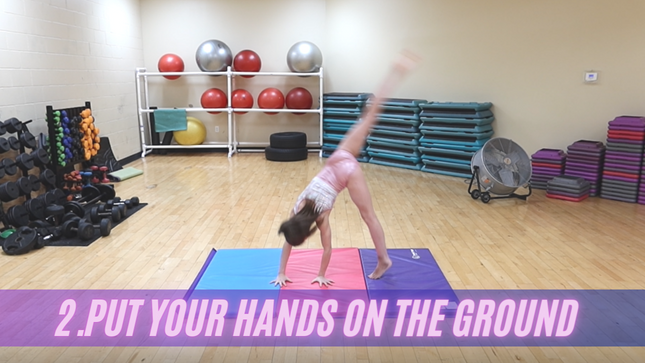
Step 2. Put your hands on the ground.
Put your hands on the ground with your hands turned 90 degrees.
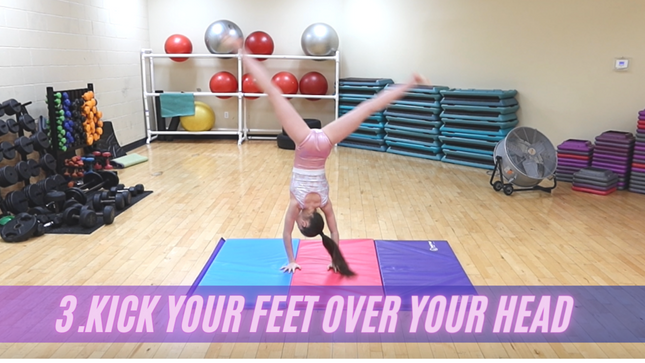
Step 3. Kick your feet over your head.
Kick your feet over your head one at a time. The foot that kicks first should land first.

Step 4. Land in a lunge.
Land in a lunge facing the opposite direction you started from. Your arms should be over your head near your ears. Your front leg should be slightly bent, and your back leg should be straight. Your “bad” leg should be the one in front.

When you are starting out, just try to kick your feet around the side of your body. Then, as you work on improving your cartwheel, you can try to kick your feet more over your head.
While you can learn a cartwheel without the help of tools, it can be easier to learn one with help. Especially for young gymnasts.
How to Do a Cartwheel Video
Muscles Needed for a Cartwheel
Performing a cartwheel engages multiple muscle groups. Strengthening these areas will improve your performance and reduce the risk of injury.
Core Muscles
- Abdominals: The rectus abdominis, obliques, and transverse abdominis help stabilize your body and maintain balance during the cartwheel.
- Lower Back: The erector spinae provides support and helps maintain a neutral spine.
Shoulders and Arms
- Deltoids: The shoulder muscles help support your body weight as you place your hands on the ground.
- Triceps: These muscles assist in pushing through the hands and maintaining stability.
Legs and Hips
- Hip Flexors: The iliopsoas and rectus femoris help lift your legs and create momentum.
- Quadriceps and Hamstrings: These muscles are crucial for the leg kick and maintaining alignment.
Wrists and Forearms
- Wrist Flexors and Extensors: These muscles support your weight and help stabilize your hands during the cartwheel.
Cartwheel Progressions
Building up to a full cartwheel involves mastering several key progressions. These exercises and drills will help you develop the strength, technique, and confidence needed to execute a perfect cartwheel.
- Wall Handstands – Kick up into a handstand against a wall with your back facing it. This builds strength and balance.
- Handstand Kick-Ups – Practice kicking up into a handstand from a standing position. Focus on controlled and consistent kicks- this helps with the kick part of the cartwheel.
- Lunge ➝ T Drill – Focus on a wide lunge and balancing in a “T” before kicking over.
- Wall Cartwheels – Perform cartwheels against a wall to help with alignment and balance. Use the wall for support and gradually reduce reliance on it. You want your back to the wall- this helps you go straight over your head.
- Partner Spotting – Have a coach or partner assist you by providing support as you practice the cartwheel. They can help guide your movement and maintain balance.
- Foam Pit Cartwheels – Practice cartwheels into a foam pit or cushioned area. This provides a safe environment to focus on technique without the risk of injury.
- Freestanding Cartwheels – Perform cartwheels without wall or partner support. Focus on smooth, controlled movements and correct form.
- Cartwheel Over a Block – Helps reinforce straight shapes and consistent motion.
- Cartwheel Down a Wedge Mat – Adds momentum and confidence with height.
- Snap Down Drill – Teaches you how to land with control.
- Power Hurdle ➝ Cartwheel – Builds speed and strength into your entry.
- One-Handed Cartwheels – Practice on both sides to improve balance and reduce hand reliance.
- Cartwheel Close – Helps with body alignment and tight finish.
- Step-In Cartwheel with Delayed Hand Touch – Builds confidence toward a hands-free aerial.
- Spotted Aerial on a Soft Mat – Gain confidence with assistance.
- Aerial Over a Block/Mat – Gives extra lift and helps you commit.
- Aerials – A cartwheel with no hands. Once you’ve mastered a regular cartwheel, you can move on to an aerial! Practice variety to build consistency.
Drills for Learning a Cartwheel
Cartwheel over the Cartwheel Block
My favorite way to teach a cartwheel is to teach it over an object. And this cartwheel block or mat is perfect for learning this way. It’s much easier to kick your feet around or over your head in this method, with your hands being raised a little bit off the ground.
To do a cartwheel over the block or mat:
- Start in a lunge.
- Turn your hands 90 degrees to either the right or left (depending on your gymnast’s dominant side).
- And kick your feet over the block to land on the other side.
Cartwheel on the Cartwheel Mat
Learning a cartwheel with a cartwheel mat is a great method for preschool children. The foot-prints and hand-prints make it easy for preschool age children to figure out where their hands should go. You can also use the back of this mat to practice doing a cartwheel in a straight line.
Cartwheel From a Knee
You can also help determine which side, right or left, will be your gymnast’s dominant side when they are tumbling with this tool. If your gymnast automatically turns her hands 90 degrees to the left, she should probably do a left cartwheel with her left foot in front in her lunge. If she automatically turns her hands 90 degrees to the right, she will probably be doing a right cartwheel.
Cartwheel on a Foam Training Beam
Once your gymnast has learned a cartwheel, it’s time to make it perfect! One of the ways to make sure your gymnast is doing a straight cartwheel is by doing it on a beam. This foam balance beam is slightly raised, but not enough that your gymnast will hurt herself if she doesn’t land directly on it.
Cartwheel on a Line on the Floor
A sticky beam strip is a great way to help your gymnast practice on a line, when you don’t want to put chalk or tape on the floors in your house. You can put this strip down, use it to practice, and take it right back up. By practicing your cartwheel on a line, you will make sure you are going right over your head.
Check out the home gymnastics equipment we recommend for practicing gymnastics at home. We have linked what we recommend for learning a cartwheel below.
Tools for Learning a Cartwheel |
Description |
Price |
| The Original Block | It’s much easier to kick your feet around or over your head in this method, with your hands being raised a little bit off the ground. | Check Current Price Here |
| Tumbl Trak Cartwheel Beam Mat | The foot-prints and hand-prints make it easy for preschool age children to figure out where their hands should go. You can also use the back of this mat to practice doing a cartwheel in a straight line. | Check Current Price Here |
| Foam Training Beam | This foam balance beam is slightly raised, but not enough that your gymnast will hurt herself if she doesn’t land directly on it. | Check Current Price Here |
| Wedge Mat |
A wedge mat can help gymnasts learn cartwheels because it creates a slight incline that makes the movement easier to understand and control. It helps them feel the correct body positioning during the sideways turn, teaches proper hand placement and weight transfer, and gives them confidence while learning how the body should move through the skill. | Check Current Price Here |
Tips for Learning How to Do a Cartwheel
- Master the hand placement: Begin by standing with your feet shoulder-width apart. Raise your arms above your head and place your dominant hand on the ground, followed by your other hand. Your hands should be shoulder-width apart and slightly turned outwards. This is where a cartwheel mat is helpful for learning a cartwheel as a beginner, especially for young children.
- Focus on the lead leg: Your lead leg (the leg that goes up first) is crucial for the momentum of your cartwheel. Practice kicking it up forcefully while reaching towards the ground with your hands.
- Follow through with the other leg: As your lead leg kicks up, let your other leg follow through, reaching for the sky. Keep both legs straight and together throughout the cartwheel motion.
- Spotting: If you’re nervous, have an adult or coach spot you. They can support your body and guide you through the proper technique until you feel comfortable doing it on your own.
- Practice drills: Practice the cartwheel drills that we have included in this article and before you know it you will be doing a cartwheel by yourself!
Frequently Asked Questions about Learning a Cartwheel
Q: What is a cartwheel and how do you do one?
A: A cartwheel is a gymnastics move where you rotate your body sideways in a horizontal plane, with one hand and then the other touching the ground as you move. To do a cartwheel, start by standing with your feet shoulder-width apart, raise your arms above your head, and then kick your leading leg up and over to the side while reaching down to touch the ground with your hand. Push off with your other leg and hand to rotate your body and land on your feet.
Q: How can I improve my cartwheel technique?
A: To improve your cartwheel technique, practice your cartwheel on a softer surface like a mat or grass to build confidence and reduce the impact on your wrists. Focus on keeping your legs straight and your body in a straight line as you rotate. Engage your core muscles to help maintain balance and control throughout the movement.
Q: What are common mistakes to avoid when learning how to do a cartwheel?
A: Common mistakes to avoid when learning how to do a cartwheel include bending your legs, not reaching down far enough to the ground with your hands, and failing to push off with enough force to rotate your body fully. Remember to keep your arms by your ears and your eyes focused on the ground to help with balance and alignment.
Q: Is it necessary to have prior gymnastics experience to learn how to do a cartwheel?
A: While prior gymnastics experience can be helpful in learning how to do a cartwheel, it is not necessary. With practice, patience, and proper technique, anyone can learn how to do a cartwheel safely and effectively. Start slowly and gradually build up your strength and flexibility to master this basic gymnastics move.
Q: How can I stay safe while practicing my cartwheels?
A: To stay safe while practicing your cartwheels, make sure to warm up properly by stretching. Always practice on a soft surface like a mat or grass to reduce the risk of injury. If you feel any pain or discomfort while performing a cartwheel, stop immediately and consult a coach or trainer for guidance on proper form and technique.
I hope this helps you master your cartwheel!
Once you have mastered your cartwheel, check out 9 other basic gymnastics skills you should master.
View Comments (119)
Sup
i am too scared to kick my legs in the air!afraid i will fall
Me too I hate kicking my legs up
What I have trouble with us putting my legs in the air staight!
Nothing will happen unless you do it by force. Just try and you just might learn (:
i was afraid too but if you just do it then you won't be scared
Be more confident. Just go for it, but don't throw yourself at it thinking of it as "confidence". That's just stupidity. Also, I'm coming from experience so I understand.
Same i'm 12 AND in CHEER CHEER ugh!
You can start practicing cartwheels in areas where falling will not hurt as much (DO NOT practice in bumpy areas where there are slopes because trust me, I know from experience that YOU WILL GET HURT).
loooser
me tooo!
TWIX!!!!!!!!!!!! TWIX!!!!!!!!!!!
I'll defenestration YOU!!!!!!!!!!!!!!
I have my cartwheel I just can’t land it in a lunge!
I am in a gymnastics class, so my teachers are tryna get me to stick the landing. I can’t! I’m 11 1/2 btw in exactly 6 months I’ll be 12. Because my half bday is today lols. Believe in urself and you’ll get there! Don’t give up I believe in you! :) byyyeee
same but i turn 12 in feb
same but i turn 12 in febuary
wow that so nice of you to say thank you for saying that now I can practice each and every day thank you
Me I don’t have enough strength in will keep trying tho
idk
Thanks
Im good
I didn't do it perfect
Neither did I.
I don't either.
I sprained my arm doing that and probably pulled a muscle
Hey
Hey how are you
I'm splended
When you do any type of gymnastic move, you must stretch your muscles. That's probably where you went wrong.
your 100% correct
Oo my
TWIX!!!!!!!!!!!!
when I do a cartwheel, I'm sure my legs aren't quite straight up and down, I'm sure that I'm wonky while doing it, how do I go 'straight up and down?? Please!! :):)
I need to know that as well.
Pretend you are a T with your body and legs staright
Did you remember to point your toes?
Insta d of landing in a lunge I always land like a rou d off
Try doing the splits in the middle of the cartwheel and landing one foot at a time.
HEY PAL!!!!!!!! This is how to do a CARTWHEEL not a ROUNDOFF!!!!!!!! GET IT RIGHT!!!!!!!!!
HEY PAL!!!!!!!! This is how to do a CARTWHEEL not a ROUNDOFF!!!!!!!! GET IT RIGHT!!!!!!!!! Or else I'm going to report you to the cartwheel police!!!!!!!!!!!
My legs are bent when i do it how do i get them straight . Other than that its great!
I am not flexible I did not do it I couldn't stretch my leg
Me too! But at least I tried !
Thanks for your help!!!.
Can you use a mattress while perfecting?