Turns in gymnastics are an important skill to make sure that you’re perfecting, especially since they’re in both beam and floor routines. Depending on whether you are participating in the Xcel Program, Compulsory or Developmental programs (or any other gymnastics program), the rules can vary slightly as well a deduction values, however, there are four main aspects of the turn that judges consider. Let’s check out and see what they are.

Completeness of the Turn
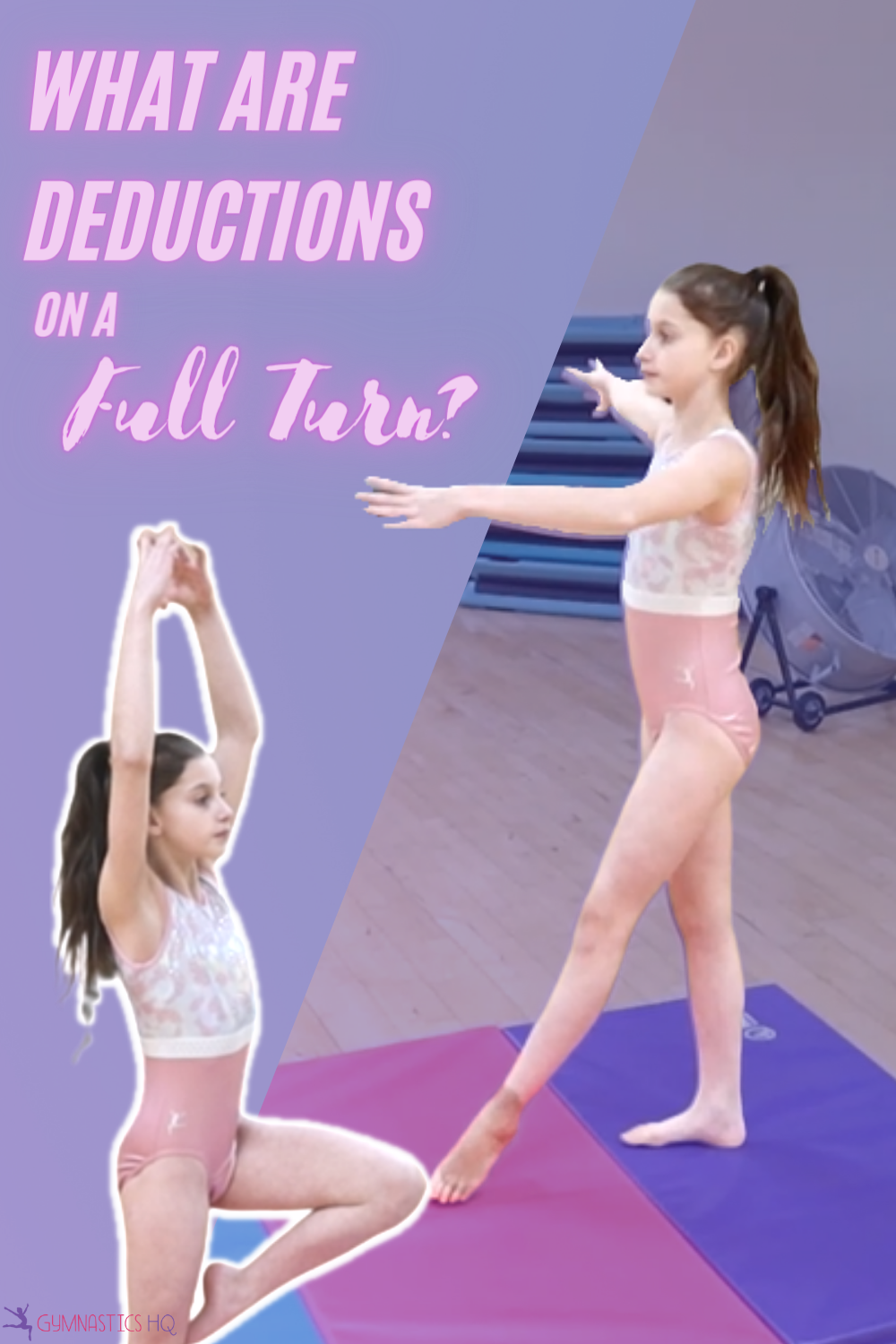
If you turn is not a complete turn, you can earn up to a .2 deduction – again, this varies depending on which program you’re competing in. You want to ensure that your turn is a complete turn. If you were to draw a circle on the ground for your turn, would you start and end in the exact same spot? If not, you can be earning deductions for this. In our example above, Skylar only performs a 1/2 turn, so if her turn was supposed to be a full turn, she might not even get credit for the skill. To practice, start with perfecting your 1/2 turns and then work up to perfecting your full turns. You can see our steps to a great full turn here.

Precision of the Turn
If you fall out of your turn, that is an obvious lack of precision, you can earn up to a .1 deduction in this area. You want your turn to be nice and clean with sharp, precise movements. In our video above, Skylar falls out of her turn, so she would receive a deduction for lack of precision in her turn.

High Relevé
Depending on the degree of your high relevé while performing your turn, you can receive up to a .1 deduction in this area too. In the video above, Skylar is slightly up on her toe, however, her foot is not all of the way up in high relevé, so she would have received a deduction in this area. You want to make sure that you are up in as high of a relevé as possible in your full turn. We have some drills that can help with that in this video from 4:38-5:35.

Body Posture/Alignment
Once again, you can receive up to a .1 deduction in this area of your turn. You want your body posture to be straight up and down so that your alignment is good. You need to stay in a tight, straight body position throughout your turn to reduce the deduction. In our video above, Skylar is not straight up and down, which throws her alignment off, however her overall body posture is relatively good, so the deduction would be smaller. You can see what your body posture should be like in this video at 1:17.
Since you can pretty much practice your turns anywhere, these are a great skill to practice at home! Check out these other skills that are easy to practice at home.
View Comments (16)
What should I do??? I can’t do a backhand spring!!!! Does anyone have tips or Drills that may help me?
https://gymnasticshq.com/backhandspring/
I'm a competitive gymnast, and it took me forever to get it. I think just become comfortable with it. U can totally do whatever u put ur mind to. God will help
Love, Emma.
help!! i keep falling on my full turn! its so inconsistent!
Keep practicing! You'll get it!
at home try practicing half turns until you have it constantly, then attempt your fullturn, it takes a lot of power but you can do it!!
Exactly! Definitely something you can work on at home!
I’m trying to learn my aerial. I feel like I can do it but I keep getting a mental block and I put my hands down! My coach keeps saying to go ‘out’ but I don’t know how? Does anyone know how to explain it differently or have tips to prevent me from getting scared?
We have a post on this here: https://gymnasticshq.com/how-to-do-an-aerial-cartwheel/
Is over rotating your turn good?
Over rotating your turn just means you have too much momentum. Try doing the turn with less power, and find that “sweet spot”. Good luck!
You want to try to hit the exact spot that you started, when you finish. It's better to go a tad over though than to not complete the turn.
Does anyone have some drills for the back extension roll? I can do the steps correctly but I can’t push into a handstand
We have a post on this! https://gymnasticshq.com/how-to-do-a-back-extension-roll/
Is it better to over rotate the turn a little to make sure you get credit, or is it better to potentially end up a little short of a good full turn?
You want to make sure that you execute the complete turn, overshooting a little would be better than falling short of completing the turn.